
Hidden Waikiki: 5 Secret Spots Tourists Walk Right Past
Author: XploreRide Editorial Team
You think you know Waikiki. You’ve stood beside the Duke Kahanamoku statue, strolled through the International Market Place, and snapped the obligatory selfie in front of the pink Royal Hawaiian. The golden sand, the surf, the high-rises—it all feels familiar.
Yet there is a second Waikiki hiding in plain sight.
Most visitors walk past sacred healing stones to claim a towel spot on the beach. They stroll across ancient royal waterways without realizing water once flowed beneath their feet. They sip drinks under a famous tree without knowing it once broadcast Hawaiian music to millions of freezing mainland listeners. If you don’t know where to look, you see only a resort strip. If you do know, you see a living kingdom—complete with mana, royal gardens, and fortresses built to stop battleships.
These are not obscure locations requiring a long drive or hike. They are secret spots in Waikiki that sit steps from Kalakaua Avenue and the beach. This comprehensive guide reveals five of the most powerful hidden gems, explains their real history, shows you exactly how to find them, and shares how to visit with respect. Whether you’re searching for “the secret spot Waikiki” or simply want to experience the destination beyond the tourist surface, these places will change how you see the entire neighborhood.
Hidden Gems Checklist: Can You Find All 5?
| The Secret | Where Is It? | What It Looks Like Today |
|---|---|---|
| 1. The Healing Stones of Kapaemahu | Kuhio Beach | Four massive boulders near the police substation |
| 2. The “Invisible” Stream | Royal Hawaiian Center | Ordinary paved walkways and shopping floors |
| 3. The First Radio Tree | Moana Surfrider courtyard | Enormous banyan tree shading the Beach Bar |
| 4. The Queen’s Summer Estate | Hamohamo (near Honolulu Zoo) | Busy intersection of Liliʻuokalani & Kūhiō Avenues |
| 5. The Bomb-Proof “Fort” | Fort DeRussy Beach Park | Thick concrete walls of the U.S. Army Museum |
1. The Healing Stones of Kapaemahu (The Wizard Stones)

Image Source: https://www.bishopmuseum.org/kapaemahu/
Location: Kuhio Beach Park, near the Waikiki Police Substation, just a short walk from the Duke statue.
Thousands of people walk past these four large basalt boulders every single day. Some lean surfboards against them. Others sit on them after swimming. Please don’t.
According to Hawaiian tradition, four māhū (people of dual male and female spirit) healers named Kapaemahu, Kahaloa, Kapuni, and Kinohi arrived from Tahiti centuries ago. They possessed powerful healing knowledge. Before returning home, they transferred their spiritual power—their mana—into these stones so the healing energy would remain on Oʻahu to protect the people.
For generations the stones were revered. In the 20th century, as Waikiki transformed into a tourist playground, they were literally buried. During World War II and the postwar boom they sat under a bowling alley for more than two decades. They were rediscovered in 1963 when the bowling alley was demolished. Thanks to cultural advocates, including the renowned Hawaiian scholar Mary Kawena Pukui, the stones were preserved and formally restored to a place of honor in 1997 as Nā Pōhaku Ola o Kapaemahu a me Kapuni—the Living Stones of Kapaemahu and Kapuni.
Today a plaque shares part of the story, and the site is recognized as a significant cultural monument. Treat these stones with the same respect you would give a church or temple. Do not climb them, sit on them, drape wet towels over them, or stack smaller rocks on top (a modern tourist habit with no Hawaiian roots).
This is one of the most powerful secret spots in Waikiki precisely because it is so visible yet so widely overlooked.
2. The Stream You Can Only Truly See with Imagination (or XR Technology)
Location: Ground floor and lower levels of the Royal Hawaiian Center, between the Royal Hawaiian and Moana Surfrider hotels.
Walk through the shopping center and you are crossing the former path of ʻĀpuakēhau Stream (sometimes called Muliwai o Kawehewehe). For centuries this was one of the three major streams that fed Waikiki’s vast wetland system. Fresh water flowed from the mountains of Mānoa and beyond, nourishing extensive loʻi kalo (taro patches) and loko iʻa (fishponds). The stream emptied into the ocean near what is now the stretch between the Royal Hawaiian and Moana hotels—the heart of ancient Helumoa.
Waikiki was never just a beach. It was a productive agricultural and aquaculture landscape that sustained Native Hawaiian communities. In the 1920s the Ala Wai Canal was dug to drain the wetlands and make land available for hotels and roads. The streams were channelized, paved over, or redirected. Today concrete and retail floors hide what was once a thriving ecosystem.
Standing in the Royal Hawaiian Center, you can still sense the ghost of the waterway. Some interpretive elements acknowledge the history, but the full picture of the former abundance requires either deep historical knowledge or technology that reconstructs the past. This is one of the clearest examples of how the modern resort city sits directly atop a completely different landscape.
3. The Tree That Helped Launch Modern Hawaii Tourism
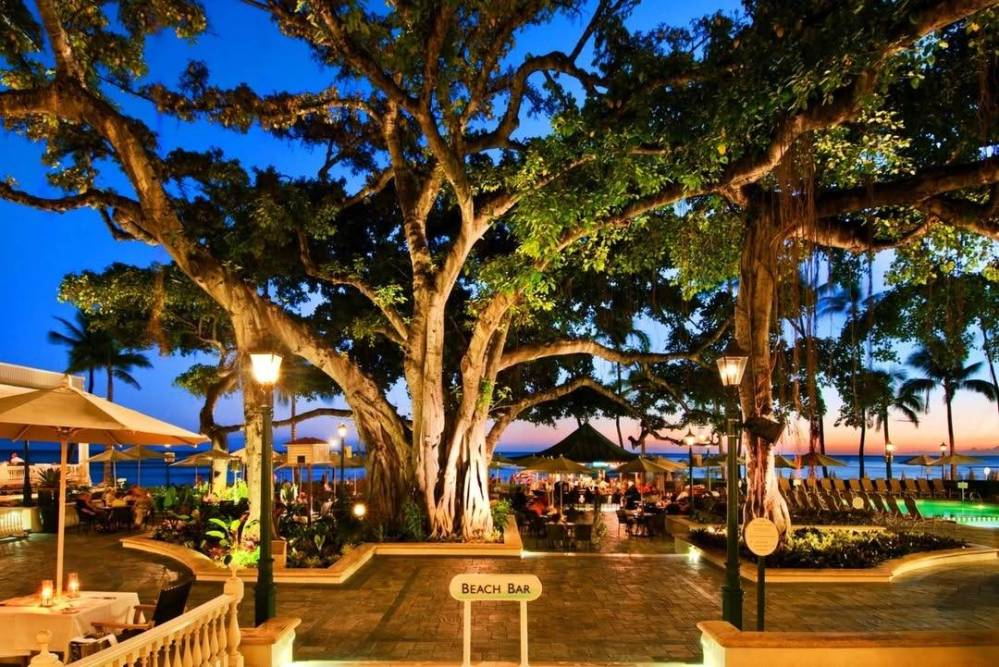
Image Source: Instagram: themoanasurfrider
Location: Courtyard of the Moana Surfrider, A Westin Resort & Spa, right on Waikiki Beach.
The massive banyan tree that fills the Moana Surfrider’s oceanfront courtyard is more than beautiful shade. Planted in 1904 as a young seven-foot specimen, it has grown into a sprawling giant with aerial roots and a canopy that defines the space.
From 1935 onward, the live radio program Hawaii Calls was frequently broadcast from under this tree (and other Waikiki locations). Hosted by Webley Edwards, the show mixed the sound of waves, live Hawaiian music, and storytelling. It reached millions of listeners across the U.S. mainland—many of them in cold climates—and is widely credited with helping create the romantic image of Hawaii that fueled the postwar tourism boom.
The same courtyard and hotel also carry a quieter legend. Jane Stanford, co-founder of Stanford University, died at the Moana in 1905 under mysterious circumstances involving strychnine poisoning. Some staff and guests report sightings of a woman in Victorian dress, and the hotel occasionally appears on local ghost tours.
Sit under the banyan with a drink and you are occupying one of the most culturally and historically layered secret spots in Waikiki—the place where modern tourism marketing and Hawaiian music first reached a mass American audience.
4. The Queen’s Summer Home at Hamohamo
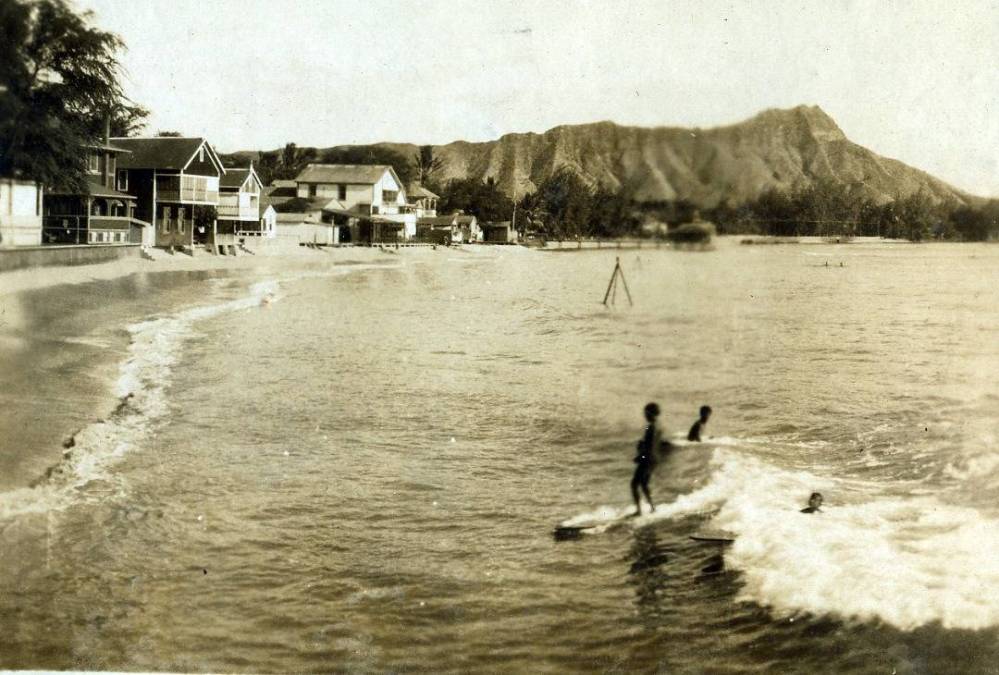
Image Source: Images of Old Hawai’i
Location: The area around the intersection of Liliʻuokalani Avenue and Kūhiō Avenue, near the Honolulu Zoo and Kapiʻolani Park.
Many visitors stay in hotels on Liliʻuokalani Avenue without knowing why the street carries that name. This district was once called Hamohamo (“to rub gently”). It was the personal summer estate of Queen Liliʻuokalani, the last reigning monarch of the Hawaiian Kingdom.
She maintained two homes here: Paoakalani and the larger Keʻalohilani closer to the beach. In these cottages she composed music, including the famous “Aloha ʻOe,” and enjoyed the sea and the healthy climate of the area. Historical accounts note that she sometimes opened her gardens to the public, allowing commoners to picnic on royal grounds—an expression of aloha that stood in contrast to stricter European royal traditions.
After the overthrow of the monarchy in 1893 and the later development of Waikiki, the cottages disappeared and high-rises rose in their place. Today only the street names and historical markers remain. Standing at the intersection, you are on ground that once belonged to Hawaii’s last queen. It is one of the most quietly powerful secret spots in Waikiki because almost nothing physical survives except the memory and the place names.
5. The Hotel That Was Built to Be Bomb-Proof
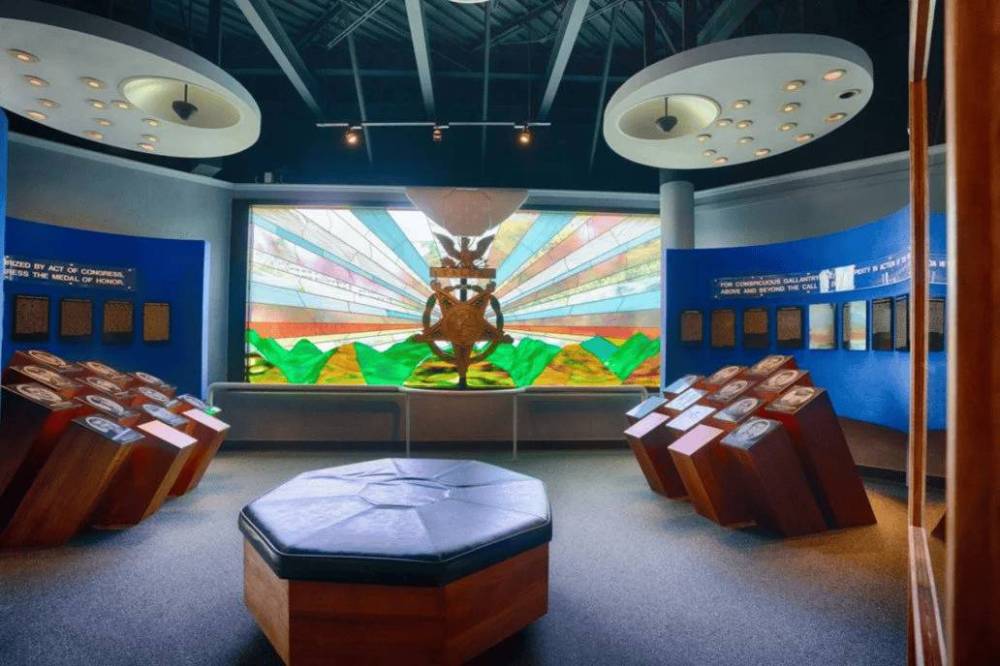
Image Source: https://www.hiarmymuseumsoc.org/exhibits
Location: U.S. Army Museum of Hawaiʻi inside Battery Randolph at Fort DeRussy Beach Park.
The concrete structure that houses the free U.S. Army Museum looks unusually solid for a museum—and for good reason. Battery Randolph was constructed between 1909 and 1911 as a coastal artillery battery. Its purpose was to defend Honolulu Harbor and Pearl Harbor approaches with massive 14-inch disappearing guns.
The walls and roof are made of steel-reinforced concrete. Sources describe thicknesses of up to 12 feet overhead and the equivalent of roughly 20–30 feet on the seaward side when accounting for the original earth cover. The battery was designed to survive a direct hit from a battleship’s main guns.
After the guns were removed following World War II, the structure was used for storage. In the late 1960s and early 1970s, developers attempted to demolish it to make way for a hotel. The wrecking ball literally bounced off the walls. The demolition company reportedly went bankrupt trying. Eventually the Army kept the battery and opened the U.S. Army Museum of Hawaiʻi inside it in 1976.
Admission is free. Outside you can see tanks and helicopters. Inside, exhibits cover Hawaiian military history from the Kingdom era through modern times, including a Cobra attack helicopter suspended from the ceiling. Kids especially love outdoor vehicles. This is both a genuine historical fortification and one of Waikiki’s best free attractions—another secret spot most beachgoers never enter.
Cultural Protocol: How to Visit These Places Respectfully
These are not just photo backdrops. They are wahi pana—storied places—with ongoing cultural meaning.
- Do not move or stack rocks on or near the Kapaemahu stones. Rock stacking is a recent tourist invention, not a Hawaiian practice.
- Do not leave food offerings unless you are a trained cultural practitioner. Food attracts pests and can damage the site.
- Keep statues, stones, and markers free of wet towels, swimsuits, or personal belongings.
- Speak and move with awareness. These places still hold mana for many people.
Simple respect is the best offering you can leave.
Mini-Itinerary: The One-Hour “Secret Waikiki” Walking Route
- Begin at Fort DeRussy / Battery Randolph (U.S. Army Museum). Walk the exterior and, if open, step inside the free museum.
- Continue east along the beachfront or Kalakaua Avenue toward the Royal Hawaiian Center. Pause and imagine the ʻĀpuakēhau Stream flowing beneath the pavement.
- Enter the Moana Surfrider courtyard and sit for a few minutes under the historic banyan tree.
- Continue to Kuhio Beach and the four Kapaemahu stones near the police substation. Pay respects.
- If energy remains, walk toward the Liliʻuokalani / Kūhiō intersection to stand on the former Hamohamo grounds.
Prefer air-conditioned comfort and deeper visual storytelling? A guided historical experience that uses archival imagery and reconstruction technology can cover the same ground (and more) in about 45 minutes while revealing layers that are invisible to the naked eye.
What Travelers Discover When They Look Closer
“I didn’t know what it was like to sign up and it was a lot of fun. I found myself hooked.
Children and adults alike can enjoy” — 千孝 石 (TripAdvisor)
“It was an amazing experience!!! It was such a smooth ride and the graphics were so cool! I loved the interactive part with the mana stones, gave you the choice to choose what you wanted to see. I also love how they stressed ways to keep our natural resources healthy!” — Kalene R. (TripAdvisor)
“It’s very realistic and educational. Our family liked so much. We felt we are in the ocean!
Thank you for the great experience.” — William C. (TripAdvisor)
These reactions are common. Once you know the stories, the same stretch of beach and sidewalk feels completely different.
Frequently Asked Questions About Waikiki’s Secret Spots
- Can I visit the Kapaemahu stones at night?
Yes. They sit in a public beach park and are illuminated. Many people find the atmosphere more peaceful after the daytime crowds leave.
- Is the U.S. Army Museum kid-friendly?
Very. Children enjoy the outdoor tanks, helicopters, and the dramatic concrete structure itself. Inside exhibits include large vehicles and engaging displays.
- Why are there ducks near the canals in Waikiki?
They are exploring the last remnants of the old wetland system. Before the Ala Wai Canal drained the area in the 1920s, Waikiki was a vast network of taro fields, fishponds, and marshes.
- Is the Moana Surfrider really haunted?
Staff and guests have reported sightings of a woman in period clothing believed to be Jane Stanford for many years. The stories are persistent enough that the hotel appears on some local ghost tours.
- Are there other secret spots nearby?
Yes. The broader Waikiki Historic Trail includes additional markers, and the former royal and agricultural landscape extends well beyond these five sites. The five highlighted here are among the most accessible and meaningful for first-time or returning visitors.
Why These Secret Spots Matter
Waikiki is often reduced to a checklist of beach, shopping, and sunset. That version of the place is real—but incomplete. The healing stones, the buried stream, the radio tree, the queen’s former gardens, and the bomb-proof battery remind us that this land has carried sacred, royal, agricultural, and strategic meaning for centuries.
Knowing even a little of that history does not diminish the pleasure of the beach. It deepens it. You begin to see the continuity between the Kingdom, the Territory, and the modern resort city. You notice street names, concrete textures, and open spaces with new eyes.
The next time you walk Kalakaua Avenue or step onto Kuhio Beach, look a little closer. The secret spots are still there, waiting for anyone willing to see them.
Waikiki is more than a beach. It is a living history book. You just have to know how to read it.